A field guide · 193 pages · 9 frameworks · 60+ swipe headlines
Become a paid copywriter in 90 days, even if you’ve never written a real ad
The 193-page field guide and 57-page working toolkit that take you from “I want to be a copywriter” to your first ₹15,000 paid project, using the same nine frameworks senior writers use at agencies in Mumbai, Bangalore, New York, and London.
PDF · DRM-free · Instant download



Used by junior writers at D2C, SaaS, and edtech brands.

“I'd been writing copy for two years before I read this. Every framework in here was something I was doing badly by feel. The OCPB structure alone fixed body copy I'd been quietly embarrassed by. The Toolkit's discovery-call agenda landed me a ₹35,000 retainer in week two. Clients respond differently when you walk in with a real process. This is the book I'll be going back to over and over for every new project.
Take a sneak peek
Drag the corner of the page or tap the arrows to turn.
You’ve watched the videos, paid for the course, and added “digital marketer” to your LinkedIn | nobody is hiring
You finished the BBA, the B.Com, the engineering degree, the journalism course. You watched a hundred YouTube videos. You paid ₹4,000 for a “digital marketing certification” that taught you how to set up a Google Ads campaign on a fake account. You added “Digital Marketer” to your LinkedIn.
Six months later, you’re sending cold messages to agency owners on Instagram and getting left on read. The internships you do find pay ₹8,000 a month and want you to make Reels for a coaching brand. Your parents keep asking when you’re going to get a “real job.”
The problem isn’t you.
Indian colleges teach marketing as theory. Foreign-led courses teach platforms (Meta Ads Manager, GA4, SEMrush) like the platform is the skill. Neither one teaches the thing senior marketers actually do all day, the thing every campaign in every country has needed for the last seventy years and will need for the next seventy.
They never taught you to write copy.
Copy is the words on the landing page. The headline of the ad. The first line of the email. The thing the prospect actually reads before they decide to buy. Without it, the ad does nothing, the email does nothing, the SEO traffic bounces.
Agencies in India pay ₹40,000 to ₹1.5 lakh a month for this skill. Freelancers charge $50 to $300 an hour on Upwork and Contra. It’s the only marketing skill you can build a portfolio in.
It’s also the skill almost nobody bothers to teach you properly.
The one marketing skill that still pays when AI does the rest of the work
The honest answer to “will AI replace copywriters” is: AI replaces beginners who never learned the fundamentals. It does not replace people who understand who they’re writing to, what the prospect already believes, and how to move them from one decision to the next.
That second group is small. The companies that need them are not. D2C brands, SaaS startups, agencies, founders, edtech, fintech, healthcare, real estate. They’re everywhere.
Here’s what the math currently looks like.
| Path | Indian rates | Intl. rates |
|---|---|---|
| Junior at an Indian agency | ₹25k–₹50k / mo | — |
| Freelance, 6 mo, Indian clients | ₹15k–₹40k / project | — |
| Freelance, 1 yr, Indian clients | ₹40k–₹1.5L / mo | — |
| Freelance, 1 yr, US/UK clients | — | $1,500–$5,000 / mo |
| Freelance, 2+ yrs, US/UK clients | — | $5,000–$15,000 / mo |
| In-house at a US/UK SaaS | — | $80k–$140k / yr |
The gap between Indian beginner and Indian beginner working internationally is a passport-free pay rise of 4–8x. The skill is the same. The frameworks are the same. The only differences are confidence, a small portfolio, and a few additions you can pick up in a weekend.
The same models senior writers use, taught simply enough to apply on a real client this week
Most beginners learn copywriting through one viral Twitter thread at a time. We compressed the entire foundation into nine frameworks, every one of them testable on a real piece of work the day you read it.
Decides whether your hook even lands. Worked examples from Cred, Mamaearth, Zerodha, Cult.fit.
One reader, one idea, one offer, one action. The discipline behind every great piece of copy.
What the reader is silently asking on every line. Miss one and they bounce.
Objection, Claim, Proof, Benefit. The unit that does most of the work in body copy.
Useful, Urgent, Unique, Ultra-specific. Score every headline you write.
The two-pass system that takes a draft from “okay” to “ships”.
The seven-bucket framework that gives you words your reader actually uses.
The three-section structure that holds long-form sales pages together.
How to take what you’ve learned and start charging US/UK/AU rates.
The book teaches the frameworks | the Toolkit is the 57-page workbook that turns reading into shipping
Most copywriting books leave you nodding. The Toolkit is the difference between “I get it” on Sunday and a finished landing page in your client’s inbox by Friday.
Reading a 193-page book on copywriting changes how you think. Filling in a real RIOA brief on a real project, on the actual deadline, is what changes how much you get paid.
The Toolkit is five modules of fillable templates, swipe files, and contracts that turn every chapter of the book into a working session. It’s designed to sit open on your desk while you work.
Research Pack
RIOA brief worksheet, Voice of Customer sheet, messaging hierarchy worksheet, spit-draft starter. Turn a fuzzy brief into a writing plan in under two hours.
Headline Vault
60+ headline swipes across 9 categories — pain hooks, identity hooks, number-led, curiosity, comparison, contrarian, offer-led, question, story-led. Brand-led examples you'll recognise.
Pricing & Contracts
Rate card by experience in ₹ and $. Proposal template, Service Agreement with GST + TDS handling, scope of work, invoice template, advance request, and a 3-step late-payment reminder sequence.
Editing Toolkit
CUB checklist, Swappy checklist, combined editing worksheet for long pieces, plus a 60-second pre-send sweep.
Client Onboarding
First-DM script, 30-minute discovery call agenda with timestamps, kickoff doc, weekly update template, and the project-wrap email with testimonial request.
This bundle is the right fit if you can tick three of these five
✓ This is for you
- 0–3 years into a marketing, content, or copywriting career
- College student or fresh grad picking which marketing skill to bet on first
- Freelancer guessing every time you open a blank doc
- Founder writing your own copy and watching it not convert
- Want to land your first international client (US/UK/AU rates) in twelve months
× This is not for you
- You want a “10x with AI prompts” course
- You want a Discord and weekly live calls
- You’ve been writing copy for 5+ years already
- You want a quick win without doing the prompts
If you’re in the right column, please don’t buy it.
Any of this sound familiar?
Hundreds of beginners have been exactly where you are now. Here’s what they were thinking, and what we’d say back.
“But I’m not a real writer.”+
“What if no one hires me?”+
“I have no portfolio yet.”+
“What if AI replaces copywriters?”+
“I don’t have time right now.”+
“I don’t have ₹999 right now.”+
Hi, I’m Aditya

Aditya Pratap Singh
Engineer turned marketer. Eight years in marketing for Indian brands and international clients. I started writing on Twitter for fun, learned the frameworks the hard way, and have since built marketing functions for fintech, edtech, Web3, D2C, and construction clients.
This book teaches something that's getting lost in the noise of social media. I see every beginner marketer trying to learn tools, but the tools don't cut the noise anymore. The skills covered in this guide are timeless and build something fundamental that you can apply to any marketing job and outperform 90% of the people.
Here’s exactly what comes in the Bundle
Most copywriting courses charge ₹15,000+ for less than half of this. We priced it for the audience that actually needs it.
| What you get | Standalone value |
|---|---|
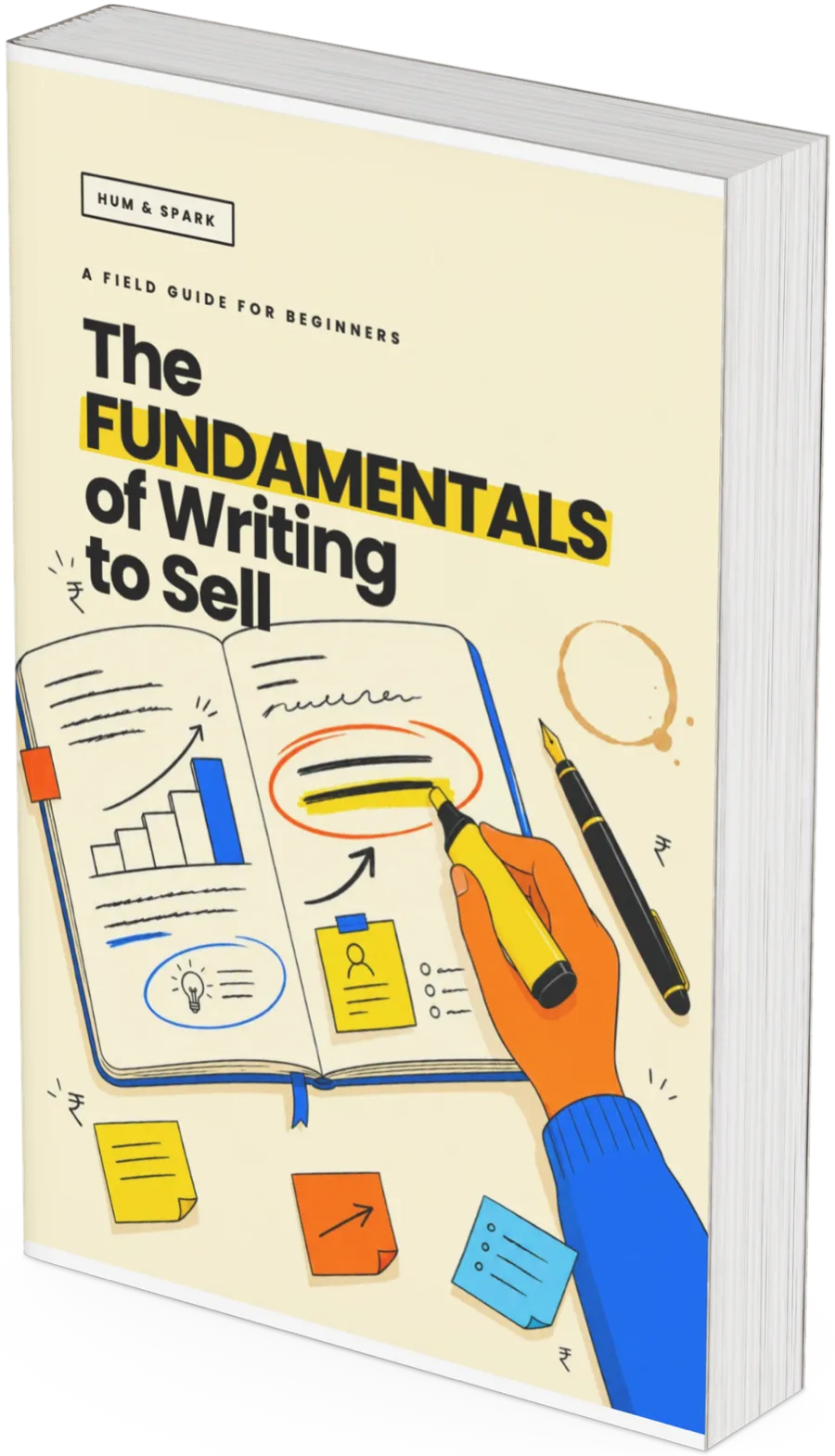
| The Fundamentals of Writing to Sell — 193-page illustrated PDF, 27 chapters, 9 frameworks, 100+ illustrations | ₹499 |
| The Beginner Copywriter's Toolkit — 57-page printable PDF, fillable A4 worksheets, fully designed | ₹799 |
| The Notion version of the Toolkit — duplicate to your workspace in one click, every template editable | ₹599 |
| The Headline Vault — 60+ headline swipes across 9 categories with brand-led examples | ₹399 |
| Service Agreement + Scope of Work + Invoice templates — GST + TDS handling, late-payment sequence | ₹999 |
| Quick Reference Card Pack — all 9 frameworks on one screenshot-friendly page | ₹199 |
| Lifetime access to updates — every new edition, free, forever | priceless |
| Total stack value | ₹3,494 |
| Today | ₹499 |
Two ways to start | one obvious choice
The Book
Best for readers
- 193-page illustrated PDF
- 9 senior frameworks
- 27 metro-ride chapters
- Quick Reference card pack
- Lifetime access to updates
The Bundle
Best for doers
- Everything in the book (193-page PDF)
- 57-page Toolkit PDF (printable A4, fillable)
- Editable Notion workspace (one-click duplicate)
- 60+ headline swipes across 9 categories
- Service Agreement + invoice templates (GST + TDS)
- Client onboarding scripts and discovery agenda
- Lifetime access to updates
₹200 more, ₹2,995 in extras.
The honest answers
What's the difference between the book and the Toolkit? +
Can I just buy the Toolkit? +
I already use Notion. Will the Notion Toolkit work for me? +
How much can I make in 90 days? +
Is this only for Indian readers? +
How long does it take to read? +
Will AI make this book obsolete? +
Is it a printed book? +
Can I share it with a friend? +
How do I pay if I’m in India? +
Can my company buy this for the team? +
Most beginners stay beginners because they keep waiting to feel ready
The honest reason most marketing graduates never get good is not lack of talent. It’s that they never sat down with a real framework and applied it to a real piece of copy under real time pressure. They keep watching one more YouTube video, taking one more course, planning to start “soon.”
This bundle is six to eight hours of reading and a few weekends of doing the prompts. By the end of it you’ll know more about copywriting than 90% of the people you’ll meet in your first three years of work, including the ones running agencies. That’s not a flex about the bundle. It’s a comment on how low the floor is.
The next step is twelve clicks and ₹499.